Primordial Nitrogenase
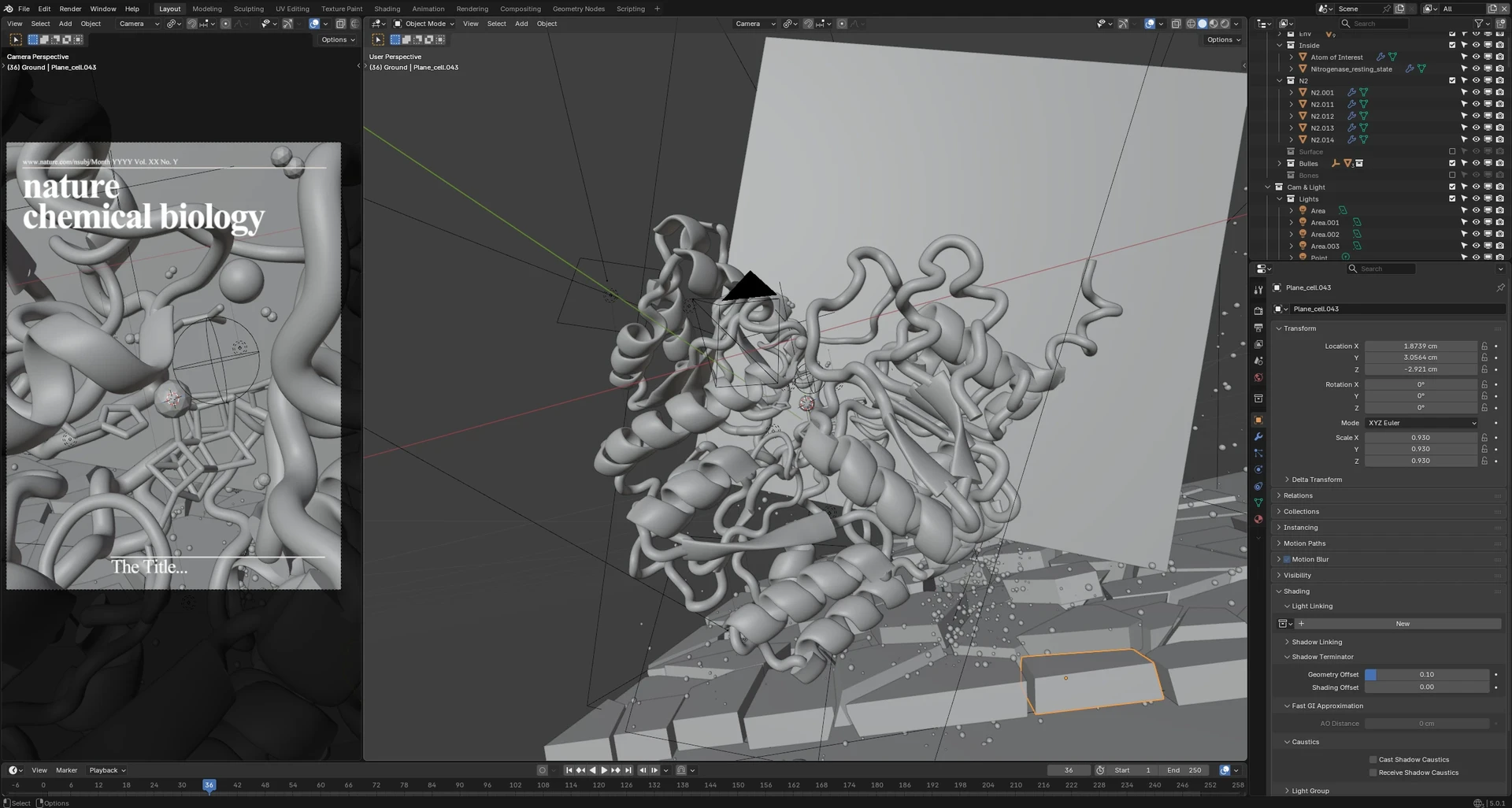
I made this cover to illustrate an article by Tristan Wagner, published in Nature Communications. It examines how a heat-loving microorganism from the deep sea converts nitrogen gas from the atmosphere into ammonia.
The authors studied the nitrogen-fixing enzyme from Methanocaldococcus infernus, an organism that grows at around 92 °C. They purified the enzyme, measured its activity and heat resistance, and used X-ray crystallography to determine its structure at near-atomic detail. The enzyme remained stable at temperatures close to boiling water and showed structural features that help it function in such extreme conditions.
The structures also captured several stages of the enzyme’s activity, including how it transfers electrons and changes its metal-containing active site while breaking apart nitrogen molecules. These observations help explain how different forms of nitrogenase work and may guide future efforts to develop lower-carbon ways of producing ammonia.